The search has to be between 2 and 50 characters

Advertisement
Advertisement
Advertisement

Current weekly ad Menards - Valid from 04/02 to 12/31 - Page nb 97

Advertisement
Advertisement
Advertisement


Advertisement
Weekly ad Menards 04/02/2026 - 12/31/2026
Weekly ad Rural King - Circular Mar 1, 2026 - Jun 26, 2026
Rural King - Circular
Mar 1, 2026 - Jun 26, 2026
Weekly ad Aldi - In Store Ad Jun 3, 2026 - Jun 9, 2026
Aldi - In Store Ad
Jun 3, 2026 - Jun 9, 2026
Weekly ad Rural King - Circular Mar 1, 2026 - Jun 26, 2026
Rural King - Circular
Mar 1, 2026 - Jun 26, 2026
Weekly ad Lowe's - Weekly Ad May 28, 2026 - Jun 10, 2026
Lowe's - Weekly Ad
May 28, 2026 - Jun 10, 2026
See next flyer
Advertisement
Advertisement


Advertisement

Products in this weekly ad

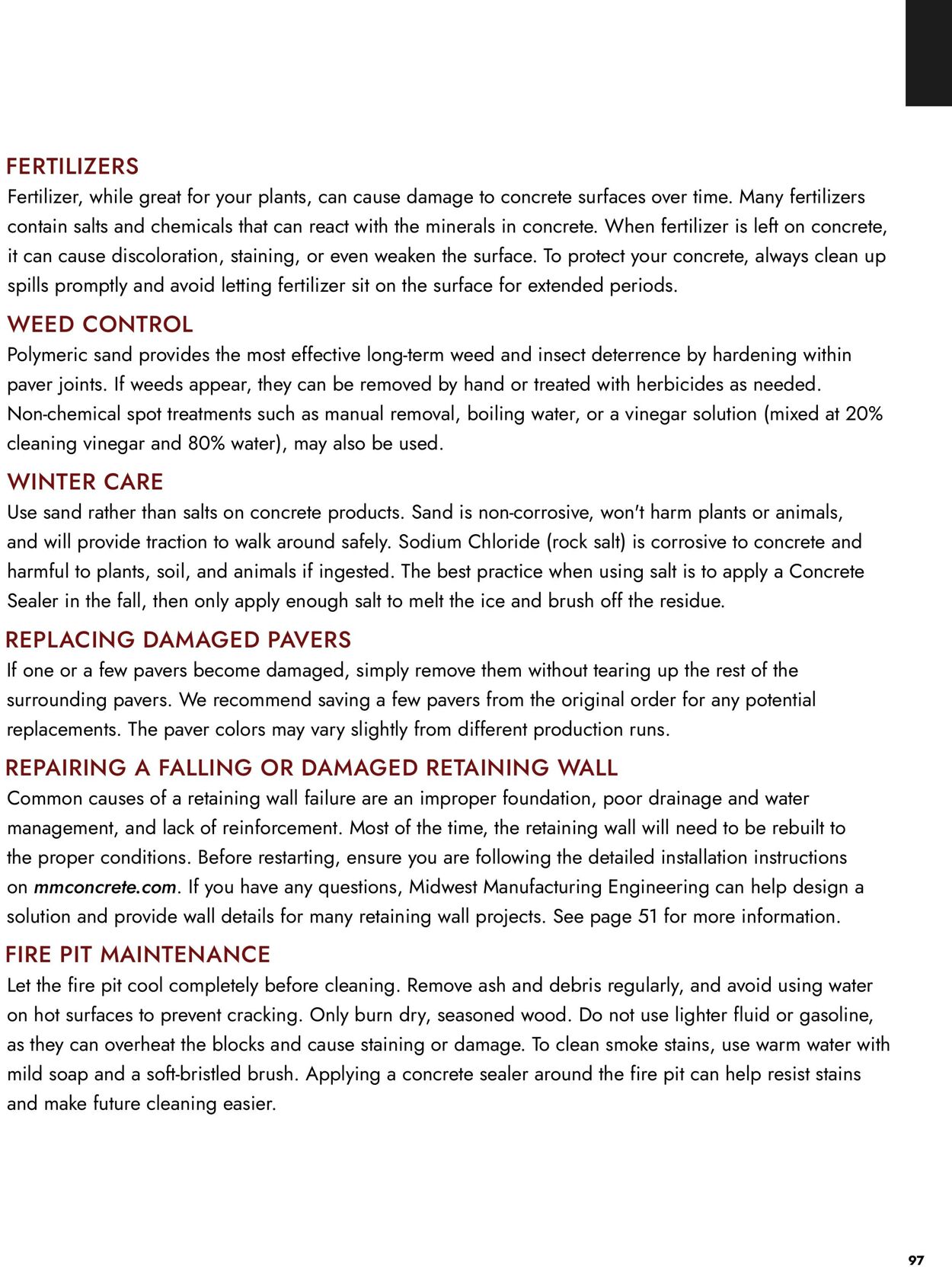
FERTILIZERS Fertilizer, while great for your plants, can cause damage to concrete surfaces over time. Many fertilizers contain salts and chemicals that can react with the minerals in concrete. When fertilizer is left on concrete, it can cause discoloration, staining, or even weaken the surface. To protect your concrete, always clean up spills promptly and avoid letting fertilizer sit on the surface for extended periods. WEED CONTROL Polymeric sand provides the most effective long-term weed and insect deterrence by hardening within paver joints. If weeds appear, they can be removed by hand or treated with herbicides as needed. Non-chemical spot treatments such as manual removal, boiling water, or a vinegar solution (mixed at 20% cleaning vinegar and 80% water), may also be used. WINTER CARE Use sand rather than salts on concrete products. Sand is non-corrosive, won't harm plants or animals, and will provide traction to walk around safely. Sodium Chloride (rock salt) is corrosive to concrete and harmful to plants, soil, and animals if ingested. The best practice when using salt is to apply a Concrete Sealer in the fall, then only apply enough salt to melt the ice and brush off the residue. REPLACING DAMAGED PAVERS If one or a few pavers become damaged, simply remove them without tearing up the rest of the surrounding pavers. We recommend saving a few pavers from the original order for any potential replacements. The paver colors may vary slightly from different production runs. REPAIRING A FALLING OR DAMAGED RETAINING WALL Common causes of a retaining wall failure are an improper foundation, poor drainage and water management, and lack of reinforcement. Most of the time, the retaining wall will need to be rebuilt to the proper conditions. Before restarting, ensure you are following the detailed installation instructions on mmconcrete.com. If you have any questions, Midwest Manufacturing Engineering can help design a solution and provide wall details for many retaining wall projects. See page 51 for more information. FIRE PIT MAINTENANCE Let the fire pit cool completely before cleaning. Remove ash and debris regularly, and avoid using water on hot surfaces to prevent cracking. Only burn dry, seasoned wood. Do not use lighter fluid or gasoline, as they can overheat the blocks and cause staining or damage. To clean smoke stains, use warm water with mild soap and a soft-bristled brush. Applying a concrete sealer around the fire pit can help resist stains and make future cleaning easier. 97


Latest weekly ads

Advertisement
FERTILIZERS Fertilizer, while great for your plants, can cause damage to concrete surfaces over time. Many fertilizers contain salts and chemicals that can react with the minerals in concrete. When fertilizer is left on concrete, it can cause discoloration, staining, or even weaken the surface. To protect your concrete, always clean up spills promptly and avoid letting fertilizer sit on the surface for extended periods. WEED CONTROL Polymeric sand provides the most effective long-term weed and insect deterrence by hardening within paver joints. If weeds appear, they can be removed by hand or treated with herbicides as needed. Non-chemical spot treatments such as manual removal, boiling water, or a vinegar solution (mixed at 20% cleaning vinegar and 80% water), may also be used. WINTER CARE Use sand rather than salts on concrete products. Sand is non-corrosive, won't harm plants or animals, and will provide traction to walk around safely. Sodium Chloride (rock salt) is corrosive to concrete and harmful to plants, soil, and animals if ingested. The best practice when using salt is to apply a Concrete Sealer in the fall, then only apply enough salt to melt the ice and brush off the residue. REPLACING DAMAGED PAVERS If one or a few pavers become damaged, simply remove them without tearing up the rest of the surrounding pavers. We recommend saving a few pavers from the original order for any potential replacements. The paver colors may vary slightly from different production runs. REPAIRING A FALLING OR DAMAGED RETAINING WALL Common causes of a retaining wall failure are an improper foundation, poor drainage and water management, and lack of reinforcement. Most of the time, the retaining wall will need to be rebuilt to the proper conditions. Before restarting, ensure you are following the detailed installation instructions on mmconcrete.com. If you have any questions, Midwest Manufacturing Engineering can help design a solution and provide wall details for many retaining wall projects. See page 51 for more information. FIRE PIT MAINTENANCE Let the fire pit cool completely before cleaning. Remove ash and debris regularly, and avoid using water on hot surfaces to prevent cracking. Only burn dry, seasoned wood. Do not use lighter fluid or gasoline, as they can overheat the blocks and cause staining or damage. To clean smoke stains, use warm water with mild soap and a soft-bristled brush. Applying a concrete sealer around the fire pit can help resist stains and make future cleaning easier. 97

Advertisement
Advertisement
Advertisement
Advertisement

If you continue to browse this website, you accept the use of cookies.

Name Details